
How to Source Reliable Crude Oil Internationally: A B2B Procurement Guide

Price is often the first consideration when sourcing crude oil internationally. But for a serious B2B buyer, price is only one part of the transaction.
A competitive offer is not useful if the crude grade does not match the refinery's requirements, the supplier cannot demonstrate authority to offer the product, the delivery schedule does not work, or the total landed cost changes the economics of the transaction.
Reliable crude oil sourcing therefore starts with a clear procurement requirement, appropriate supplier and counterparty evaluation, confirmed product specifications, realistic logistics, and a complete view of commercial costs.
This guide explains how procurement teams can approach international crude oil sourcing and where an experienced crude oil broker or commercial brokerage partner can support the process.
Have an active crude oil procurement requirement?
If you already know your crude grade, quantity, destination and delivery timeframe, you can submit your requirement to Fulcrum Commercial Brokerage. Include as much relevant specification and commercial information as possible.
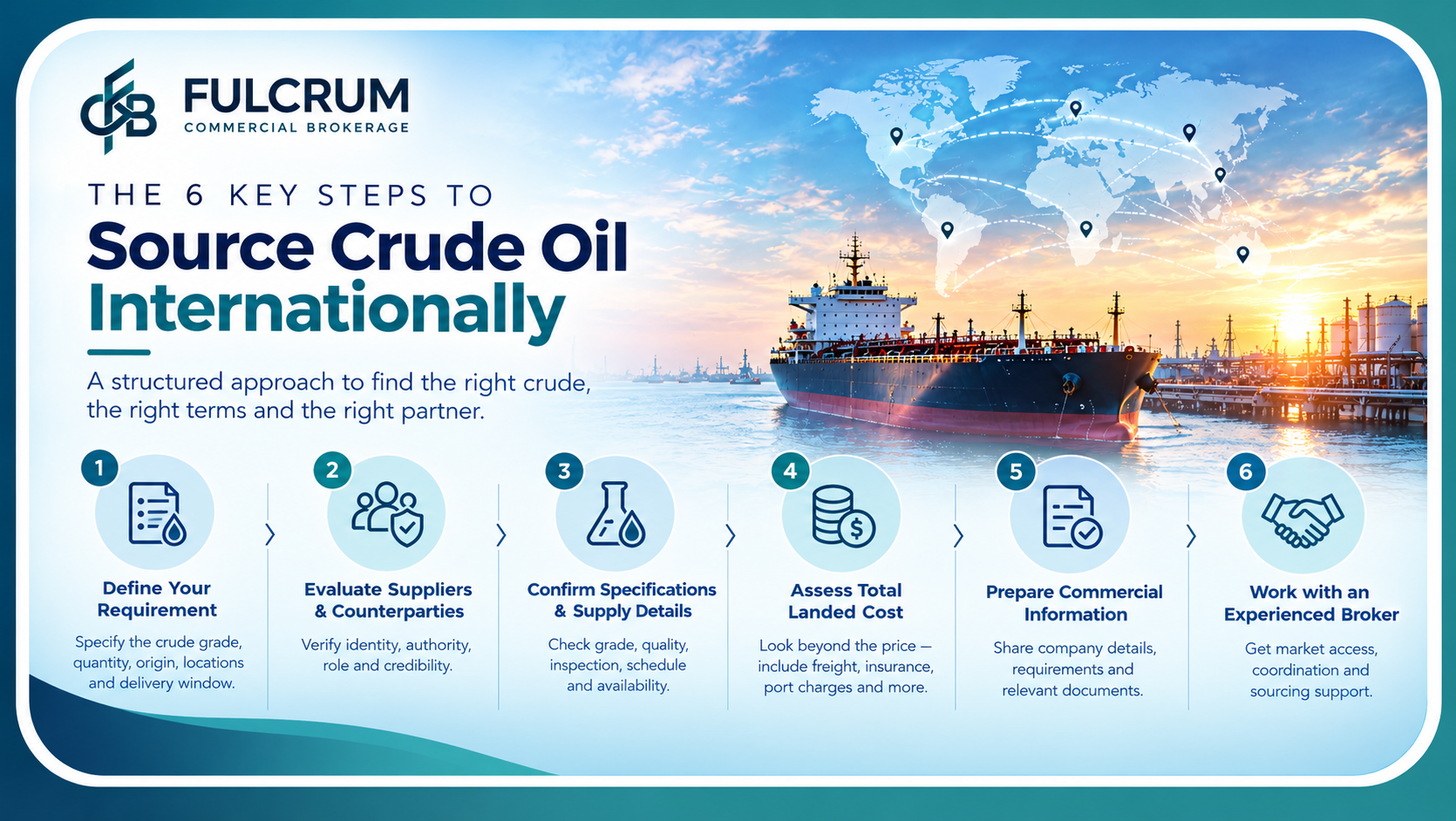
How to Source Crude Oil Internationally: 6 Key Steps
A structured procurement process can help buyers evaluate opportunities more consistently.
- Define the required crude grade, quantity, origin, loading and discharge locations, and delivery window.
- Identify the counterparty's role and establish its authority to offer the product.
- Confirm crude oil specifications, inspection arrangements and supply schedule.
- Compare offers using total landed cost rather than headline price alone.
- Prepare company and commercial information and understand which documents may apply.
- Work with an experienced brokerage partner when market access or sourcing support can add value.
1. Define Your Crude Oil Procurement Requirement
Effective crude oil procurement starts with a clear requirement.
An enquiry that simply states "crude oil, best price" provides very little information for a potential supplier or sourcing partner. A detailed procurement brief makes it easier to identify opportunities that actually fit the buyer's needs.
At a minimum, consider providing:
- Crude grade or reference: The required grade, benchmark or acceptable quality range.
- API gravity and sulfur content: Important characteristics that help determine whether a crude is suitable for a particular refinery or end use.
- Origin: Preferred, required or excluded producing regions where applicable.
- Quantity: Required volume per cargo and, for term requirements, expected monthly or annual volume.
- Purchase type: Spot cargo or longer-term supply requirement.
- Loading location: The expected origin or loading point.
- Discharge location: Destination port, terminal or delivery location.
- Delivery timeframe: Required loading or arrival window.
- Commercial requirements: Preferred delivery terms, inspection requirements and other relevant conditions.
The more precise the requirement, the easier it becomes to identify a crude oil supplier whose product and commercial terms may fit the buyer.
2. Evaluate Potential Crude Oil Suppliers and Counterparties
Finding a potential international crude oil supplier is only the beginning of the procurement process.
The party presenting an offer may be a producer, refiner, trading company, broker or another intermediary. Understanding its role is important before commercial discussions progress.
When evaluating a potential supplier or counterparty, consider:
Corporate Identity
Confirm the legal identity of the company, its registered details and relevant corporate information through appropriate independent sources.
Role in the Transaction
Understand whether the party is:
- The producer
- The seller
- A trading company
- An authorized representative
- An intermediary
The buyer should understand how the party is connected to the proposed supply.
Authority to Offer the Product
Where appropriate, establish that the counterparty has a legitimate basis for offering the specific crude grade, volume and delivery arrangement.
Product Availability
A credible offer should provide meaningful information about:
- Grade
- Origin
- Loading point
- Quantity
- Availability
- Delivery timeframe
A generic claim that large quantities are "available immediately" without supporting information should receive additional scrutiny.
Commercial Capability
Where appropriate, buyers can use references, advisers, financial institutions and other legitimate due-diligence resources to evaluate the counterparty.
Compliance
International transactions may require appropriate sanctions, know-your-customer and other compliance checks depending on the parties, jurisdictions and transaction structure.
A very low price, unclear product origin, unexplained intermediary structure or pressure to provide funds or sensitive banking information early in the process can all justify additional due diligence.
The level of due diligence should reflect the size and structure of the proposed transaction.
3. Confirm Crude Oil Specifications and Supply Details
An attractive commercial offer is only useful if the product actually meets the buyer's requirements.
Before moving further with a transaction, confirm the relevant details in writing. These may include:
- Crude grade
- API gravity
- Sulfur content
- Other relevant quality specifications
- Quantity and applicable tolerance
- Product origin
- Loading location
- Delivery location
- Inspection arrangements
- Quality and quantity verification
- Supply schedule
- Spot or term structure
For refinery procurement teams, product compatibility is particularly important.
The objective should be to find crude that fits the buyer's operational and commercial requirements rather than changing the requirement simply to accommodate an unsuitable offer.
4. Evaluate the Complete Commercial Cost
International crude oil procurement should not be evaluated on headline price alone.
Crude oil transactions may be priced using a benchmark together with an agreed differential, but the final commercial economics can also depend on logistics and transaction-specific costs.
Depending on the structure, buyers may need to consider:
- Crude oil purchase price
- Price differential
- Freight
- Insurance
- Inspection
- Port charges
- Terminal charges
- Storage
- Financing costs
- Taxes and duties, where applicable
- Other delivery-related costs
For example, two offers with similar headline pricing can produce different overall economics when freight, inspection, delivery terms and other costs are included.
For this reason, procurement, finance, shipping and legal teams should evaluate the complete transaction rather than relying on the initial quoted price.
5. Understand the Role of a Crude Oil Broker
A crude oil broker acts as an intermediary between relevant buyers and sellers and can facilitate commercial communication during the sourcing process.
A broker does not necessarily own the crude oil being offered. The underlying sale remains between the relevant counterparties according to the terms they negotiate and agree.
Depending on the transaction, a crude oil brokerage company may support buyers with:
- Structuring and communicating the procurement requirement
- Identifying potentially relevant suppliers or counterparties
- Facilitating communication between parties
- Supporting commercial discussions
- Coordinating information during the sourcing process
- Facilitating broader trade discussions where appropriate
A brokerage relationship should be clearly understood from the beginning. Buyers should know who the broker represents, what information is required, how the broker is compensated where applicable, and what role the broker has in the transaction.
A broker can provide market access and commercial coordination, but it does not replace the buyer's own legal, financial, technical and compliance due diligence.
Looking for a crude oil sourcing or brokerage partner?
If you have an active commercial requirement, provide your crude grade, quantity, destination and delivery timeframe through Fulcrum's Sale Request page.
6. Prepare Your Commercial Procurement Information
Buyers with a clearly prepared procurement brief can make the initial sourcing process more efficient.
Depending on the transaction, relevant information may include:
- Company information: Legal company name, registration information and business activity.
- Product requirement: Required crude grade and specifications.
- Quantity: Required cargo volume or term requirement.
- Destination: Discharge port, terminal or delivery location.
- Delivery timeframe: Required loading or arrival window.
- Purchase structure: Spot or longer-term requirement.
- Commercial requirements: Preferred delivery terms, inspection requirements and other relevant conditions.
Certain transactions may also involve documents such as a Letter of Intent (LOI), Irrevocable Corporate Purchase Order (ICPO), Documentary Letter of Credit (DLC), Standby Letter of Credit (SBLC), or Non-Circumvention and Non-Disclosure Agreement (NCNDA).
However, these documents are not universally required. Their relevance depends on the transaction, counterparties, jurisdiction, commercial structure and applicable procedures.
Buyers should understand the purpose and implications of any document or financial instrument before issuing it and should consult their appropriate legal, banking and compliance advisers where necessary.
How to Choose a Crude Oil Supplier for Your Requirement
When comparing potential suppliers, use a consistent evaluation framework rather than focusing on one attractive part of an offer.
| Factor | Question to Answer |
|---|---|
| Product fit | Does the crude grade and specification match the refinery or end-use requirement? |
| Quantity | Can the required volume be supplied per cargo or per month? |
| Availability | Is the supply connected to a defined origin, loading point and timeframe? |
| Delivery | Do the loading and discharge locations fit the required schedule? |
| Documentation | Can the counterparty provide clear and consistent documentation? |
| Counterparty | Are the company's identity, role and authority reasonably verifiable? |
| Commercial terms | Are pricing, delivery and payment terms clear and workable? |
| Logistics | Are freight, inspection and port arrangements realistic? |
| Overall suitability | Does the complete transaction work from loading through discharge? |
A supplier should therefore be evaluated on the overall suitability of the transaction, not simply on the lowest quoted price.
If important aspects of an offer remain unresolved after reasonable due diligence, it is sensible to address those issues before progressing further.
How Fulcrum Commercial Brokerage Can Support Crude Oil Procurement
For buyers looking for an international sourcing or brokerage partner, the value of a commercial intermediary can extend beyond simply introducing two parties.
Fulcrum Commercial Brokerage is based in Doha, Qatar, and operates in international oil, gas and petrochemical markets.
Its services include commercial brokerage and sourcing activities involving areas such as:
- Crude oil
- Refined petroleum products
- Energy and fuels
- Gas and power
- LNG and related energy products
- Petrochemicals
- Chemicals and minerals
For a buyer with a defined crude oil requirement, Fulcrum can support the commercial sourcing process by helping communicate the requirement, identify potentially relevant market opportunities, facilitate discussions between counterparties and support the broader commercial process where appropriate.
The value of a brokerage relationship depends on the specific requirement, available opportunities and terms agreed between the relevant parties. Buyers should continue to perform their own technical, commercial, legal and compliance due diligence throughout the transaction.
Have an Active Crude Oil Procurement Requirement?
If you are currently looking for a crude oil supplier or exploring international crude oil sourcing opportunities, start with a clear procurement brief. Include:
- Crude grade and specifications
- Required quantity
- Origin preferences, if applicable
- Destination
- Delivery timeframe
- Spot or term requirement
- Other relevant commercial requirements
A complete requirement makes it easier to determine whether relevant sourcing opportunities may exist and what additional information may be needed for the initial commercial review.
Submit Your Crude Oil Requirement
If your company has an active crude oil procurement requirement, you can submit the details to Fulcrum Commercial Brokerage through the Sale Request page.
Submit Your Crude Oil RequirementFrequently Asked Questions
Start by clearly defining your crude grade, quantity, destination and
delivery requirements. Then evaluate potential suppliers based on product
availability, corporate identity, authority to offer the product,
documentation, commercial terms, logistics and appropriate due diligence.
A buyer should ideally provide the required crude grade and specifications,
quantity, destination, delivery timeframe, purchase structure and relevant
commercial requirements. More detailed information can make supplier
matching more efficient.
A crude oil broker can help communicate a buyer's requirement, identify
potentially relevant suppliers or counterparties, facilitate commercial
discussions and support the sourcing process. The exact role depends on the
transaction and agreement between the parties.
Consider the supplier's corporate identity, role in the supply chain,
authority to offer the product, product specifications, availability,
documentation, delivery arrangements, commercial terms and relevant
compliance requirements.
Yes. A commercial brokerage company can facilitate connections and
discussions between international buyers and sellers. However, the specific
availability, transaction structure and counterparties depend on the
individual procurement requirement.
A supplier or seller provides the crude oil under the agreed transaction
terms. A broker generally acts as an intermediary that facilitates
connections and commercial communication between relevant parties. A broker
does not necessarily own the crude oil being offered.