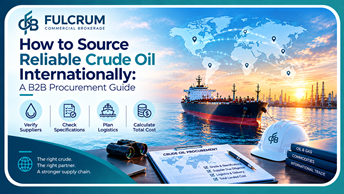
Buying Bulk Diesel Internationally: What to Check Before You Commit

Most problems in bulk diesel procurement are not simply about price. They can arise from a product specification that does not match the contract, an unverified counterparty, incomplete documentation, or delivery terms that are misunderstood.
For importers, distributors, traders, and industrial buyers sourcing diesel internationally, a structured procurement process can help reduce avoidable commercial risks. Before committing to a transaction, buyers should verify the product specification, assess the supplier, clarify delivery responsibilities, and establish the documentation, inspection, payment, and compliance requirements.
This guide explains the key checks to complete before proceeding with an international bulk diesel transaction.
Ready with your requirements?
Submit your diesel supply enquiry to Fulcrum Commercial Brokerage for assessment.
Start with the Product Specification, Not the Price
Supplier quotations are only meaningfully comparable when they refer to the same product specification. Before requesting offers, define the required diesel grade and the technical parameters that the product must meet.
Consider the following factors:
- Applicable standard: Identify the relevant fuel specification for your intended application and destination. EN 590 and ASTM D975 are common references where applicable, but the required standard must be confirmed for the specific transaction.
- Sulphur content: Confirm the maximum permitted sulphur level under the applicable specification and import requirements.
- Technical parameters: Establish the required limits for density, viscosity, cetane properties, flash point, and cold-flow characteristics where relevant.
- Intended use: Road transport, industrial equipment, generators, and other applications may have different fuel requirements.
- Quality verification: Determine which certificates, laboratory tests, and inspection procedures will be required to demonstrate conformity.
Record the agreed specification clearly in the contract. If a supplier proposes an alternative grade, assess it separately and obtain written approval before proceeding. A similar product description is not sufficient evidence that the fuel meets your requirements.
Define Your Requirements Before Contacting a Supplier
A clear commercial enquiry helps potential counterparties assess whether the requested transaction can be considered.
Prepare the following information before requesting a quotation:
- Quantity: State the required volume and measurement unit, such as metric tonnes or cubic metres.
- Supply frequency: Specify whether the requirement is a one-time purchase or a recurring supply arrangement.
- Destination: Identify the destination country and discharge port, where applicable.
- Delivery schedule: Provide the preferred shipment or delivery window.
- Delivery terms: State your preferred Incoterm, such as FOB or CIF, where appropriate.
- Payment arrangements: Identify any proposed payment instrument or commercial conditions, subject to verification and negotiation.
- Documentation and inspection: Specify required certificates, inspection procedures, and compliance documentation.
Providing accurate details at the outset helps reduce misunderstandings and allows the parties to assess the commercial requirements more efficiently.

Verify the Counterparty Before Making a Commitment
In international fuel trading, a professional-looking quotation does not, by itself, establish that a counterparty has the authority or capability to fulfil a transaction. Conduct appropriate due diligence before signing a contract or transferring funds.
Check the company's identity
Verify the company's registration details, legal identity, business address, and authorised representatives through reliable records. Confirm that the people negotiating the transaction are authorised to act on behalf of the organisation they represent.
Understand the counterparty's role
Determine whether the counterparty is a producer, cargo owner, authorised seller, trader, broker, or another intermediary. An intermediary is not automatically a problem, but its role and authority in the transaction should be understood and documented.
Review product origin and traceability
Ask for appropriate evidence of product origin and traceability where required. The information should be consistent with the proposed transaction and any applicable trade-compliance obligations.
Cross-check transaction documents
Check company names, product descriptions, quantities, dates, ports, and contractual details across the documents provided. Inconsistencies should be clarified before proceeding.
Obtain independent advice where appropriate
For substantial or unfamiliar transactions, consider engaging a trade lawyer, compliance adviser, customs specialist, or independent inspection company.
Be cautious of unexplained pricing discrepancies, pressure to make early payments, inconsistent documentation, or reluctance to answer reasonable verification questions. No single warning sign proves misconduct, but unresolved concerns should be addressed before a commitment is made.
FOB vs CIF: Understand the Delivery Terms
FOB and CIF are commonly used for international maritime commodity transactions. They allocate different responsibilities for freight, insurance, and delivery, so buyers should understand the terms before comparing offers.
| Consideration | FOB — Free on Board | CIF — Cost, Insurance and Freight |
|---|---|---|
| Main sea freight | Generally arranged by the buyer | Arranged and paid for by the seller to the named destination port |
| Cargo insurance | Generally arranged by the buyer | Arranged by the seller for the buyer's benefit under the applicable rule |
| Risk transfer | Generally when the goods are on board the vessel at the shipment port | Generally when the goods are on board the vessel at the shipment port |
| Buyer considerations | Freight, insurance, and destination arrangements | Insurance adequacy, destination costs, and discharge arrangements |
Important: Under CIF, the seller pays the cost of freight and arranges the required cargo insurance, but risk generally transfers to the buyer when the goods are loaded on board at the shipment port—not when the cargo arrives at its destination.
The minimum insurance required under CIF may not be sufficient for every buyer's risk-management needs. Review the policy coverage, exclusions, insured value, and claims procedures before accepting the arrangement.
FOB and CIF are intended for sea and inland waterway transport under Incoterms rules. The appropriate term depends on the transaction and transport method. Always specify the named port and applicable Incoterms edition in the contract. For the official rules, consult the International Chamber of Commerce's Incoterms information.
Request and Verify the Required Documentation
Documentation requirements depend on the product, transaction structure, transport method, and destination. Establish the required document list with your customs broker, inspection provider, and relevant advisers before shipment.
Documents commonly requested in international fuel transactions may include:
- Commercial invoice
- Product specification sheet
- Certificate of quality or certificate of analysis
- Certificate of origin, where required
- Bill of lading for applicable sea shipments
- Customs and import documentation
- Independent inspection report, where agreed
- Other documents required under the contract or applicable regulations
Confirm who is responsible for issuing each document, when it must be provided, and how discrepancies will be resolved.
Do not assume that receiving a document automatically establishes its authenticity or proves that the product meets the contract. Where appropriate, verify documents with the issuing organisation or an independent professional.
Agree on Independent Product Inspection
Independent inspection can help buyers verify whether the product's quality and quantity conform to the agreed contractual requirements.
Before the transaction proceeds, document the inspection arrangements, including:
- Who appoints the inspector and who pays the associated costs
- Where and when sampling and measurement will take place
- Which testing methods and standards will apply
- How the results will be reported
- What constitutes acceptable quality and quantity
- What happens if the inspection identifies a discrepancy
The inspection procedure should be agreed upon before loading or delivery. This reduces the risk of disagreements over testing methods, acceptance criteria, and responsibility for non-conforming cargo.
Inspection arrangements should also be consistent with the contract's payment conditions, delivery obligations, and remedies for non-performance.
Check Import Regulations and Trade-Compliance Requirements
International diesel transactions can be affected by fuel-quality regulations, customs procedures, import authorisations, sanctions, and other trade restrictions.
Before signing, confirm that the product, its origin, the transaction parties, the proposed route, and the intended end use comply with the requirements applicable to the transaction.
The checks may include:
- Applicable fuel-quality and product standards
- Import permits or authorisations, where required
- Customs declarations and duties
- Country-of-origin documentation
- Sanctions screening and restricted-party checks
- Transportation, storage, and terminal requirements
- Other applicable trade and environmental obligations
These requirements can change over time and may differ between jurisdictions. Obtain current guidance from the relevant authorities or qualified trade-compliance professionals rather than relying solely on a previous transaction or a generic checklist.
How to Compare Bulk Diesel Offers Properly
The lowest quoted price is not necessarily the most competitive commercial offer. Compare quotations using the same specification, quantity basis, delivery terms, and contractual assumptions.
Review the following eight factors:
- Product specification: Does the offered grade meet the required technical parameters?
- Quantity: Is the volume clearly stated, including any permitted tolerance?
- Pricing basis: Is the price fixed or calculated using an agreed benchmark or formula?
- Delivery terms: Are the Incoterm, named port, freight responsibilities, and destination costs clear?
- Documentation: Are the required documents identified, with responsibilities and deadlines specified?
- Payment terms: Are payment instruments, milestones, release conditions, and safeguards documented?
- Inspection arrangements: Are the inspector, testing procedures, and acceptance criteria agreed upon?
- Contractual protections: Does the contract address non-delivery, non-conforming product, dispute resolution, and governing law?
Comparing these elements provides a more complete view of the commercial offer than evaluating the quoted price alone.
Common Risks in International Bulk Diesel Procurement
Even a well-planned transaction can face operational or commercial challenges. However, a structured review can help identify potential problems before the parties commit.
Common risks include:
- Specification mismatches: The supplied fuel does not meet the agreed technical requirements.
- Unverified counterparties: The supplier's identity, authority, or role has not been adequately established.
- Incomplete documentation: Missing or inconsistent records delay verification or customs clearance.
- Unclear delivery responsibilities: Ambiguous terms create unexpected freight, port, or handling costs.
- Payment exposure: Payment conditions provide insufficient protection if contractual obligations are not fulfilled.
- Compliance issues: Product origin, transaction parties, or import arrangements do not meet applicable requirements.
- Logistical delays: Vessel schedules, terminal capacity, inspections, or customs procedures affect the shipment.
Many of these risks can be reduced through checks before signing, while problems discovered after payment or shipment can be more difficult and costly to resolve.
Working with Fulcrum Commercial Brokerage
Fulcrum Commercial Brokerage provides a channel for businesses to submit commercial requirements in the energy and commodity brokerage sector.
For a bulk diesel enquiry, buyers should clearly communicate the required grade, specification, volume, destination, preferred delivery terms, and target schedule. This information helps establish the scope of the requirement for assessment.
Any potential transaction remains subject to counterparty verification, product and documentation checks, applicable compliance requirements, and contractual terms agreed by the relevant parties. Buyers should independently verify all material representations and commercial arrangements before committing funds.
Ready to discuss your requirements?
Submit your bulk diesel supply enquiry to Fulcrum Commercial Brokerage.
Frequently Asked Questions
You should define the required product specification, quantity, destination, delivery schedule, and preferred Incoterm. You should also verify the counterparty and establish clear requirements for documentation, inspection, payment, and import compliance.
The appropriate standard depends on the intended application and applicable destination requirements. EN 590 and ASTM D975 are common references where relevant, but buyers must confirm the exact required grade and technical parameters before entering into a contract.
Under FOB, the buyer generally arranges the main sea freight. Under CIF, the seller arranges and pays for freight and the required cargo insurance to the named destination port. Under both terms, risk generally transfers when the goods are on board the vessel at the shipment port, subject to the applicable Incoterms rule.
Depending on the transaction, documents may include a commercial invoice, product specification sheet, certificate of quality or analysis, certificate of origin, bill of lading, customs documentation, and inspection report. Confirm the exact requirements before shipment.
Verify the company's registration, authorised representatives, and documented role in the transaction. Cross-check the commercial documents and product information, and consider independent legal, compliance, or inspection advice for substantial transactions.
Independent inspection can help establish whether the product's quality and quantity meet the agreed contractual requirements. The inspection scope, sampling method, testing standards, and acceptance criteria should be agreed upon in advance.
Yes. Requirements depend on the product, origin, transport route, destination, transaction structure, and applicable regulations. Confirm the current requirements with the relevant authorities and qualified advisers before committing to a shipment.
Conclusion
Buying bulk diesel internationally requires more than finding an attractive quotation. Product specifications, counterparty verification, documentation, independent inspection, delivery terms, and trade compliance all contribute to a more informed procurement decision.
By defining requirements early and checking the key commercial details before committing, buyers can reduce avoidable uncertainty and assess potential transactions more effectively.
If your business is exploring a bulk diesel requirement, prepare your specifications, quantity, destination, and preferred delivery terms, then submit your enquiry to Fulcrum Commercial Brokerage for assessment.
Disclaimer: This article provides general commercial information and is not legal, technical, customs, tax, or investment advice. Buyers should independently verify product specifications, counterparties, documentation, regulatory requirements, and contractual terms for each transaction.